
Python is everywhere. You may not see it directly on your phone screen or computer dashboard, but behind the scenes, Python quietly powers many of the tools, apps, and systems people use every single day.
When Netflix suggests your next binge-worthy show, when your bank catches a suspicious transaction before you even notice it, or when a hospital system helps a doctor spot a disease early — there’s a good chance Python is working somewhere in that process.
So, what is Python used for in real life? A lot, actually. It’s used in web development, data science, artificial intelligence, finance, healthcare, and so much more.
And here’s the thing — whether you’re a student just starting out or a working professional trying to keep up with the tech world, understanding Python’s real-world value isn’t just useful. It’s becoming kind of essential.
What Is Python? (Quick Overview)
Python is a programming language — but not the intimidating kind. It was created back in 1991 by a guy named Guido van Rossum, and honestly, his goal was pretty simple: make coding easier to read and write for actual humans.
And it worked. Python’s syntax looks almost like plain English, which is why beginners don’t feel completely lost when they first open it.
That’s also why it got so popular. Schools teach it, companies use it, and developers love it. It’s flexible, powerful, and surprisingly easy to pick up — even if you’ve never coded before.
Key Features of Python Programming Language
Python didn’t get this popular for no reason. Here’s what makes it actually worth learning:
- Easy to Read and Write: The code looks clean and simple — almost like writing normal sentences. Even beginners can follow it without getting confused.
- Runs Line by Line: Python executes your code one line at a time. So when something goes wrong, it’s much easier to find exactly where the problem is.
- Works for Almost Everything: Web development, data analysis, machine learning, automation — Python handles all of it. You don’t need a different language for every task.
- Tons of Ready-Made Libraries: Things like NumPy, Pandas, and Django are already built. You don’t have to create everything from scratch, which saves a lot of time.
- Massive Community: Millions of people use Python around the world. So if you’re stuck on something, chances are someone has already solved it and posted the answer online.
Why Python Has Become So Popular
Honestly, Python didn’t blow up overnight — but once people started using it, they just didn’t stop.
The biggest reason? It’s easy to start. Most languages make you feel dumb in the first hour. Python doesn’t. You can write something that actually works in just a few lines of code. That’s a big deal, especially when you’re just starting out.
But here’s the thing — it’s not only beginners who like it. Even experienced developers prefer Python because it saves time. Less code, cleaner structure, easier to go back and understand what you wrote three months ago.
And it works in so many different areas. Web development, data analysis, machine learning, automation — Python fits into all of it. Most languages are good at one or two things. Python is genuinely useful across the board.
It also helps that massive companies like Google, Netflix, Instagram, and even NASA use Python in their actual systems. That’s not a small thing. When people see that, they want to learn it.
The community is huge too. Millions of developers sharing solutions, building tools, answering questions. So when you’re stuck — and you will get stuck — help is usually one search away.
Put it all together and it just makes sense why Python is everywhere right now.
| Struggling with your Python assignment? Get expert help at Best Assignment Grade and submit with confidence. |
What Is Python Used for in Real Life?
People always ask — okay, Python is popular, but where is it actually used? Fair question. Here’s an honest look at 11 real-life areas where Python shows up every single day. So if you’re wondering what is Python used for in real life, keep reading — the answer might surprise you.
1. Web Development
Python is used to build websites and web applications. Frameworks like Django and Flask make it faster and easier to create everything from simple blogs to full-scale platforms. Instagram and Pinterest — both built with Python.
Key Points
- Python powers websites using frameworks like Django and Flask.
- Instagram and Pinterest were both built using Python.
- It handles backend logic, databases, and server-side operations easily.
- Great for building everything from small blogs to large platforms
2. Data Science & Analytics
Companies collect massive amounts of data every day. Python helps them make sense of it. Libraries like Pandas and NumPy let analysts clean, sort, and study data without losing their mind doing it manually.
Key Points
- Python helps analysts clean, sort, and study large datasets quickly.
- Libraries like Pandas and NumPy make data handling much simpler.
- Businesses use it to find patterns and make smarter decisions.
- It connects easily with visualization tools like Matplotlib and Seaborn.
3. Artificial Intelligence & Machine Learning
This is probably Python’s biggest moment right now. Tools like TensorFlow, Keras, and scikit-learn are all Python-based. Every chatbot, recommendation engine, and image recognition system you’ve interacted with — Python likely had a hand in it.
Key Points
- TensorFlow, Keras, and scikit-learn are all Python-based ML tools.
- Python powers chatbots, recommendation engines, and image recognition systems.
- Most AI research happening today is written in Python.
- It’s the top language used in every major AI project right now.
4. Automation & Scripting
Got a boring, repetitive task? Python can do it for you. Renaming hundreds of files, sending automated emails, scraping data from websites — Python handles all of this with surprisingly little code.
Key Points
- Python automates boring tasks like renaming files and sending emails.
- It scrapes websites and collects data without manual effort.
- Businesses use Python scripts to save hours of repetitive work.
- Even non-developers use Python automation tools in daily workflows.
5. Cybersecurity
Security professionals use Python to write scripts for penetration testing, network scanning, and finding vulnerabilities before the bad guys do. Tools like Metasploit and many ethical hacking frameworks rely heavily on Python.
Key Points
- Security experts use Python for penetration testing and network scanning.
- It helps find system vulnerabilities before attackers can exploit them.
- Many ethical hacking tools and frameworks are built with Python.
- Python scripts can monitor networks and detect threats in real time.
6. Finance & Banking
Banks and financial firms use Python for algorithmic trading, risk assessment, and fraud detection. When your bank flags a suspicious transaction in seconds — there’s a good chance a Python model made that call.
Key Points
- Banks use Python for fraud detection and risk assessment models.
- Algorithmic trading systems rely heavily on Python for fast execution.
- Financial analysts use it to build models and forecast market trends.
- Python processes millions of transactions and flags suspicious ones instantly.
7. Healthcare & Medical Research
Python is being used to analyze patient data, assist in disease detection, and even help in drug discovery. Hospitals and research labs use Python-based models to study medical imaging like X-rays and MRIs.
Key Points
- Python analyzes patient data to assist doctors in early diagnosis.
- It helps process medical images like X-rays and MRI scans.
- Researchers use Python for drug discovery and clinical data analysis.
- Hospitals rely on Python models to improve treatment planning and outcomes.
8. Game Development
Python isn’t the first choice for big AAA games, but it’s widely used for building smaller games, prototypes, and game logic. The Pygame library makes it accessible even for beginners who want to create their first game.
Key Points
- Python’s Pygame library helps beginners build their first simple games.
- It’s widely used for game prototyping and testing game logic.
- Python handles game physics, scoring systems, and player interactions easily.
- Many game developers use Python scripts alongside engines like Unity.
9. Scientific Research
Organizations like NASA and CERN use Python to process and analyze massive scientific datasets. Researchers in physics, biology, chemistry, and astronomy rely on Python to run simulations and visualize complex data.
Key Points
- NASA and CERN use Python to process large scientific datasets daily.
- Researchers use it to run simulations and visualize complex experimental data.
- Python supports biology, chemistry, physics, and astronomy research projects.
- It makes analyzing and sharing research findings much faster and easier.
10. Education
Python is now the go-to language taught in schools and universities around the world. It’s simple enough for a 12-year-old to learn, yet powerful enough for a PhD researcher to use daily. That balance is hard to find.
Key Points
- Python is now the most taught programming language in universities worldwide.
- Its simple syntax makes it perfect for absolute beginners to start.
- Students use Jupyter Notebook for assignments, projects, and data experiments.
- Teachers prefer Python because it focuses on logic, not complex syntax.
11. Cloud Computing & DevOps
Python plays a big role in managing cloud infrastructure. Tools like Ansible and scripts used in AWS, Google Cloud, and Azure environments are often written in Python. DevOps engineers use it to automate deployments and monitor systems.
Key Points
- Python automates cloud deployments on AWS, Google Cloud, and Azure.
- DevOps engineers use Python scripts to monitor and manage systems.
- Tools like Ansible and Terraform workflows are often written in Python.
- It helps teams deploy faster, fix issues quicker, and reduce manual errors.
Why Python is More Popular Than Other Programming Languages
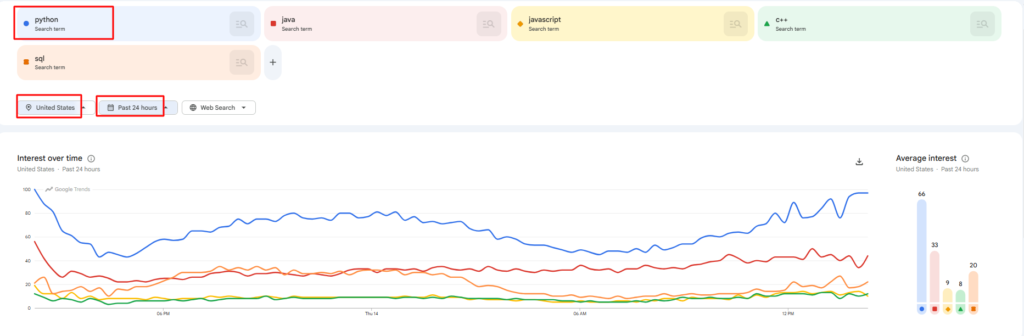
If you go to Google Trends and compare Python with Java, JavaScript, C++, and SQL — the result is pretty clear. Python sits at the top with an average interest score of 66 out of 100 in the United States in the last 24 hours. Java comes in at 33, JavaScript at 20, C++ at 9, and SQL at just 8.
That’s not even close.
People are searching for Python almost twice as much as Java, and more than three times compared to JavaScript. That kind of gap doesn’t happen by accident.
But why exactly is Python pulling ahead? Here’s the real reason:
1. It’s the easiest to start with.
2. It dominates the fastest-growing fields.
3. Companies are hiring Python developers like crazy.
4. It works for everyone..
The Google Trends graph says it clearly — Python’s interest line stays consistently higher than every other language. It’s not a trend. It’s a pattern. And right now, that pattern shows no sign of slowing down.
Is Python Hard to Learn for Students?
Honestly? No — and that’s kind of the whole point.
Python was designed to be easy to read and write. Compare it to C++ or Java, where even printing one line requires multiple lines of complex code.
In Python, you just write
print (“Hello World”) and you’re done.
For students already juggling assignments and deadlines, this makes a real difference. Python lets you focus on logic and problem-solving, not confusing syntax.
Now, it does get harder as you go deeper — object-oriented programming, libraries, machine learning concepts. Students do get stuck, and that’s completely normal.
But the Python community is massive. Thousands of free tutorials, forums, and videos mean help is always just one search away.
So no — Python isn’t hard. It’s actually one of the friendliest languages a student can start with.
Conclusion
So now you know what is Python used for in real life — and the answer is pretty much everything. Web development, data science, AI, healthcare, finance, automation — Python is quietly running behind all of it.
What makes it special isn’t just how powerful it is, but how approachable it is. Students can pick it up without feeling overwhelmed, and professionals can build serious, real-world projects with it.
Whether you’re just starting your coding journey or trying to level up your skills, Python is genuinely one of the best places to put your time and energy.
The world is moving fast. And Python is moving right along with it.
Frequently Asked Questions (FAQs)
Q1. What is Python used for in real life?
Python is used in web development, data science, AI, finance, healthcare, and automation. It powers tools and systems that millions of people interact with every single day without even realizing it.
Q2. Is Python good for beginners?
Yes, absolutely. Python has simple, clean syntax that feels close to plain English. Most students can write their first working program within hours of starting, making it one of the most beginner-friendly languages available.
Q3. Is Python still in demand in 2026?
Very much so. Python consistently tops job boards, developer surveys, and Google Trends. Fields like AI, machine learning, and data science are growing fast — and Python is the primary language powering all of them.